If you developed a hernia on the job, you’re likely facing a question that no one is giving you a straight answer to: can you keep working, or do you need to stop? At the Iskandar Complex Hernia Center, we understand that the decision isn’t purely medical — it’s financial, legal, and deeply personal. This guide walks you through what you need to know right now, from recognizing serious signs and symptoms to understanding your rights as an injured worker.
Can You Actually Keep Working With a Hernia?
The honest answer is: it depends. A hernia occurs when tissue or an organ pushes through a weak point in the surrounding muscle or abdominal wall. The most common types in workplace injuries are inguinal hernias, which develop in the groin area, and umbilical hernias, which form near the navel. How much pain you’re in and how physically demanding your job is will largely determine whether continuing to work is reasonable.
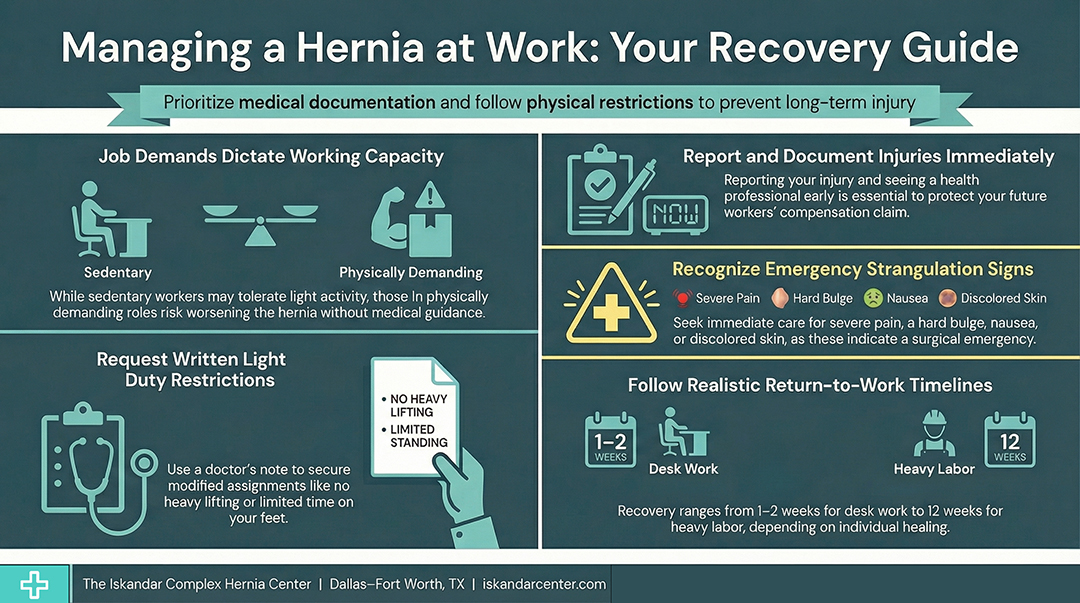
For workers in sedentary roles, light activity may be tolerable in the short term. But for those who lift, carry, strain, or spend long hours on their feet, working through a hernia without medical guidance significantly raises your risk of making it worse. Factors like obesity, repeated coughing, or anything that puts pressure on the abdomen can accelerate deterioration and create complications that require more involved intervention.
One important point most workers don’t consider: delaying a doctor’s visit or continuing to work without reporting the injury can actually undermine a workers’ compensation claim later. Report the injury, see a health professional, and get everything documented.
How to Know When a Hernia Is Too Serious to Push Through
Some hernias can be monitored with a watchful approach. Others require immediate attention. Knowing the difference could protect your health.
Seek emergency care immediately if you experience any of the following:
- A bulge in the abdomen or groin that becomes hard and cannot be pushed back in
- Sudden, severe pain at the hernia site
- Nausea, vomiting, or signs of bowel obstruction
- Skin at the hernia site that appears red, purple, or discolored
- Difficulty breathing or significant abdominal pressure with no relief
These are signs of a strangulated hernia — a condition in which the herniated tissue loses its blood supply. This is a surgical emergency that can cause permanent damage to the gastrointestinal tract if not treated immediately. Ignoring these symptoms in an effort to finish a shift is not worth the risk.
What Is Light Duty and Can You Request It After a Hernia?
Light duty refers to modified work assignments that stay within the physical restrictions set by your treating physician. In practice, this might mean no heavy lifting, limited time on your feet, or a shift to desk-based tasks. For workers with a hernia diagnosis, light duty can create the space needed to continue earning income while avoiding further strain on the injured muscle and surrounding tissue.
If your employer is covered by workers’ compensation, they are generally required to accommodate a physician’s written restrictions. A doctor’s note outlining specific limitations — no lifting over a certain weight, no exercise that strains the abdomen, no repeated bending — is your most effective tool. Get those restrictions in writing and keep a copy.
There is often a fear of being labeled a problem employee for requesting accommodations. That concern is valid, but the legal protections discussed below exist precisely to address it. Your health and your claim both depend on following medical guidance, not pushing through against your doctor’s orders.
During light duty, if your modified position pays less than your normal wage, partial disability benefits through workers’ comp may make up a portion of the difference. Ask your claims representative about your specific benefits.
When Surgery Is Necessary — And What That Means for Your Job
A surgeon will typically recommend hernia repair surgery when the hernia is growing, causing significant pain, or carries a meaningful risk of strangulation. Watchful waiting is sometimes appropriate for smaller, asymptomatic hernias — but that decision should be made with a qualified health professional who has reviewed your imaging, your activity level, and your overall health history.
Hernia repair generally involves one of two approaches: open surgery or minimally invasive laparoscopic techniques. Recovery timelines vary depending on the method, the complexity of the hernia, and the patient’s overall health. Many patients return to light activity within one to two weeks, while those in physically demanding roles may need four to twelve weeks before they’re cleared for full duty.
A case that made headlines in early 2025 illustrates why understanding your rights before surgery matters: an Amazon warehouse worker in Las Vegas developed an inguinal and umbilical hernia on the job and was subsequently fired for “non-attendance” while recovering from approved hernia repair surgery — allegedly because an automated system misclassified his approved leave as unexcused absences. aol His case is now in federal court. It’s a clear reminder that documentation and knowing your protections aren’t optional — they’re essential.
Experience renowned expertise and unparalleled compassion from the leader in hernia repair.
Returning to Work After Hernia Surgery: Realistic Timelines and Expectations
Healing from hernia repair takes time, and the pressure to return quickly — from employers, coworkers, or financial stress — is real. But coming back too soon puts your recovery and your abdominal wall at genuine risk. Re-injury means more time out of work and a potentially more complicated path forward.
General return-to-work timelines as a starting point:
- Desk or light duty: 1–2 weeks post-surgery
- Moderate physical work: 4–6 weeks
- Heavy labor or repeated strain: 6–12 weeks, depending on your surgeon’s evaluation
Your surgeon, Dr. Iskandar, will determine when you are cleared for full duty, and that clearance should be based on your individual healing progress — not a predetermined calendar. Workers’ comp typically covers the recovery period, including medical care and a portion of lost wages while you’re unable to work.
Most patients who receive proper care and allow adequate healing time do return to full capacity. The goal at the Iskandar Complex Hernia Center is always a dramatically improved quality of life — and that outcome is most achievable when recovery is taken seriously from the start.
Dealing with a hernia from work and not sure what your next step should be? Start with a consultation with Dr. Iskandar. Contact the Iskandar Complex Hernia Center at (469) 800-9832 or schedule a consultation online.
source https://iskandarcenter.com/abdominal-wall-repair/can-you-keep-working-with-a-hernia-or-should-you-stop-what-injured-workers-need-to-know-about-light-duty-surgery-and-returning-to-work/

No comments:
Post a Comment