What the research actually says about hernia recurrence, and what can be done about it
You had the surgery. You did the recovery. And then, months or years later, you felt the bulge again.
If you are reading this, you may be angry, exhausted, or quietly convinced you did something wrong. Many patients who come to The Iskandar Complex Hernia Center have been living with pain for years, and some feel embarrassed to walk back into a surgeon’s office at all.
Here is the first thing worth knowing: you are not an unusual case. Roughly one in five incisional hernia repairs is performed on a hernia that has already come back at least once (Hernia, Springer Nature, 2020). Recurrence is one of the central, unsolved problems in abdominal wall surgery, and it is studied intensely precisely because it is so common.
The second thing worth knowing is that recurrence usually has specific, identifiable reasons. Most of them have far more to do with how the hernia was repaired, and how the wound healed, than with anything you did.
This article walks through what the published evidence says. It is deliberately heavy on numbers, because you deserve the real ones.
How often do hernias actually recur?
Contemporary estimates of recurrence after ventral hernia repair range from 30% to 80%, depending on the population studied and how long patients are followed (JAMA Surgery, 2024).
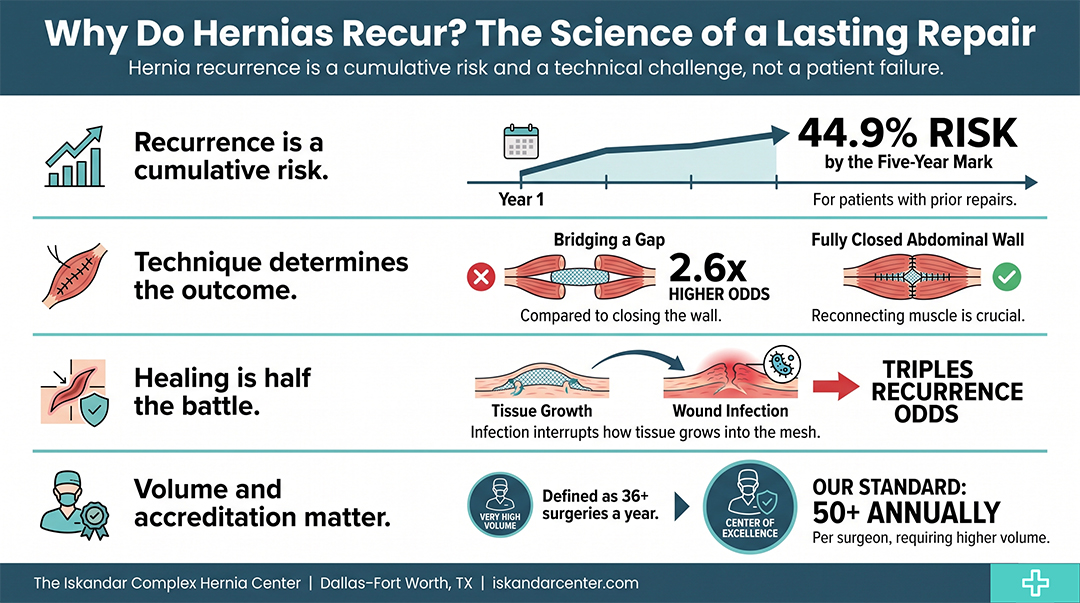
That range is uncomfortably wide. The most useful modern American data comes from the Abdominal Core Health Quality Collaborative (ACHQC), a national surgical quality registry. In a 2024 study published in JAMA Surgery, researchers tracked 35,433 U.S. patients who had already undergone at least one ventral hernia repair. What they found is that recurrence is not a single event with a single probability, it is a risk that accumulates, year after year.
Cumulative recurrence after ventral hernia repair (patients with a prior mesh repair)
| Time since repair | Cumulative recurrence |
|---|---|
| 6 months | 2.8% |
| 1 year | 8.0% |
| 2 years | 19.7% |
| 3 years | 29.3% |
| 4 years | 38.5% |
| 5 years | 44.9% |
Source: Year-Over-Year Ventral Hernia Recurrence Rates and Risk Factors, JAMA Surgery, 2024 (ACHQC registry, 35,433 patients, 2012–2022)
The curve keeps climbing. A separate nationwide analysis of 45,773 hernia repairs in Denmark found that operations for recurrence were still accumulating fifteen years after the original surgery, reaching 18–20% for incisional hernias (BJS Open, 2024). And because that figure counts only patients who went back for another operation, it almost certainly understates the true number. Plenty of people live with a recurrence without ever having it repaired again.
What this means for you: the fact that your hernia returned does not make you an outlier or a failure. It makes you part of a very large, very well-documented group.
When do recurrences show up?
This is the question patients ask most often at follow-up appointments: “It’s been three years. Am I in the clear?”
The honest answer is mostly, but not entirely. Data from the Herniamed registry, one of the largest hernia registries in the world, shows a clear pattern for incisional hernias:
| When the recurrence appeared | Share of all recurrences | Running total |
|---|---|---|
| Within the first year | 35.2% | 35.2% |
| Second year | 20.5% | 55.7% |
| Third year | 10.0% | 65.7% |
| Fourth year | 6.1% | 71.8% |
| Fifth year | 7.0% | 78.8% |
| Years 5–10 | ~2.6% per year | ~92% by year 10 |
More than a third of recurrences declare themselves in the first twelve months. Two-thirds have appeared by year three. But recurrences continue to surface for a decade or more, which is exactly why long-term follow-up after complex hernia repair is not an upsell. It is the natural history of the disease.
Reason 1: How the repair was performed
This is the part most patients are never told, and it is where the largest effects live.
The single best synthesis of this question is a 2021 systematic review and meta-analysis in BJS Open, which screened 18,214 studies and pooled data from 274 of them to identify what actually predicts recurrence (BJS Open, 2021). Nearly every number in the sections that follow comes from that analysis.
Stitches alone don’t hold. In a landmark randomized trial, incisional hernias repaired with sutures alone recurred in 63% of patients at ten years, compared with 32% when mesh was used. Even for small hernias, the split was 67% versus 17%. The authors’ conclusion was blunt: suture repair of incisional hernia should be abandoned (Annals of Surgery, 2004).
That trial ran in the 1990s, and it is the reason the field changed. It does not describe your odds today, it describes why surgeons stopped repairing these hernias with stitches. Across 48 modern studies, mesh reinforcement reduces the odds of recurrence by roughly a third compared with suture-only repair.
Whether the muscles were actually brought back together. When a hernia defect is too wide to close, some surgeons “bridge” it, laying mesh across the gap like a tarp over a hole, without reconnecting the abdominal wall muscles. It is faster. It is also associated with a 2.6-fold increase in the odds of recurrence compared with repairs where the abdominal wall is fully closed.
This is arguably the most important technical concept in this entire article, and we return to it below, because there is now a well-established way to solve it.
Where the mesh was placed. Not all mesh repairs are the same operation. Mesh positioned in the retromuscular plane, behind the muscle, recurs significantly less often than mesh laid on top of the abdominal wall (onlay) or placed inside the abdominal cavity.
What the mesh was made of. This one surprises patients: biologic mesh recurred roughly twice as often as synthetic mesh in ventral hernia repair. A randomized trial confirmed it even in contaminated surgical fields, where biologic mesh has traditionally been favored; two-year recurrence was 20.5% with biologic mesh versus 5.6% with synthetic (JAMA Surgery, 2022). Extended follow-up out to a median of 5.4 years found the same pattern held: 23.6% versus 11.8% (American College of Surgeons, 2026).
None of this means your prior surgeon did anything wrong. Complex hernia repair is genuinely difficult surgery; techniques have changed substantially in the last decade, and an approach that was reasonable in 2015 may not be the approach a specialist would choose in 2026.
Reason 2: How the wound healed
Here is the finding that reframes everything, and the one almost nobody explains to patients:
A wound infection after hernia repair more than triples the odds that the hernia will recur.
Not by 20%. Not by half. More than three times, an odds ratio of 3.21 across 24 studies. And it is not just infection. Every category of wound complication independently predicts recurrence:
| Postoperative complication | Increase in odds of recurrence |
|---|---|
| Any surgical-site occurrence | 3.65× |
| Any postoperative complication | 3.34× |
| Hematoma (blood collection) | 3.33× |
| Wound infection | 3.21× |
| Wound separation (dehiscence) | 2.21× |
| Seroma (fluid collection) | 1.99× |
Source: Identifying predictors of ventral hernia recurrence, BJS Open, 2021
These are the largest effect sizes in the entire recurrence literature, larger than obesity, larger than smoking, larger than diabetes. The landmark 2004 randomized trial found the same thing independently: wound infection was a significant predictor of recurrence.
Why? A repair has to heal to hold. Mesh does not work by mechanical strength alone; it works because your own tissue grows into it. Infection, fluid, and inflammation interrupt that process at exactly the moment it matters most.
Recurrence, in other words, is often a healing problem as much as a mechanical one. That has a direct consequence for how these operations should be planned, and by whom.
Reason 3: Factors in your own body
These matter. They are also, in most cases, the smallest of the three categories, which is worth not self-criticizing if you have been blaming yourself.
| Risk factor | Increase in odds of recurrence |
|---|---|
| Long-term steroid use | 2.08× |
| A hernia that has already recurred once | 1.88× |
| An incisional hernia (vs. a hernia with no prior surgery) | 1.79× |
| BMI over 30 | 1.54× |
| COPD | 1.53× |
| ASA class III–IV (significant medical complexity) | 1.46× |
| Diabetes | 1.36× |
| Smoking | 1.34× |
Source: Identifying predictors of ventral hernia recurrence, BJS Open, 2021
Compare those numbers to the table above. Smoking raises your odds by about a third. A wound infection more than triples them. Both matter, but the surgical and healing factors dominate.
There are mechanisms behind the modifiable risks, and they are worth understanding rather than moralizing about. Smoking reduces oxygen delivery to healing tissue and blunts the inflammatory response that knits a repair together. Excess abdominal weight raises intra-abdominal pressure, working steadily against the repair from the inside. Poorly controlled blood sugar impairs wound healing. These are not character failures. They are biology, and biology can be worked on.
The line in bold deserves special attention. A hernia that has already recurred once is significantly more likely to recur again. Every previous operation leaves scar tissue, disrupts blood supply, and distorts the anatomy. This is the single most important reason a recurrent hernia should not be treated as a repeat of the same operation, and why it belongs with a surgeon who does this work constantly.
Why every website gives you a different number on Recurring Hernias
You have probably noticed that recurrence rates online range from “rare” to “more likely than not.” There is a reason.
In that review of 274 studies, only 66 of them (24%) even defined what counted as a recurrence, and among those that did, researchers used 41 different definitions and 67 different detection methods. The median follow-up was just 24 months, which, given the timeline above, means most studies stop counting before a third of recurrences have appeared.
Anyone quoting you a single confident recurrence percentage is oversimplifying. What the evidence supports is not one number, but a set of factors, most of which are actionable.
So what actually works? Two answers, and you need both.
The procedures have genuinely improved
The bridged-repair problem described earlier, mesh spanning a gap the surgeon could not close, is the exact problem that modern posterior component separation was designed to solve. The transversus abdominis release (TAR) technique allows the surgeon to release the abdominal wall from behind, move the muscles back to the midline, close the fascia properly, and place a large mesh in the retromuscular plane where the evidence says it performs best.
The difference in the published results is substantial:
| Older anterior component separation | Modern posterior component separation (TAR) | |
|---|---|---|
| Wound complications | 20–35% | ~15% |
| Recurrence at 2 years | ~13% | ~4% |
That is real progress, and it is why a hernia that was called “unfixable” several years ago may be very fixable today.
But the surgeon performing them matters enormously
Advanced techniques only produce advanced results in hands that use them often. The evidence on this is unusually direct.
A 2024 study in JAMA Network Open examined 23,580 surgeons performing robotic-assisted ventral hernia repair and found that roughly 19 cases were required before a surgeon’s long-term reoperation rates matched those of established open and laparoscopic approaches. Fewer than 6% of surgeons ever exceeded that volume (JAMA Network Open, 2024).
Read that again. The technique works, but most surgeons performing it have not done it enough times for it to work as well as it should.
The published volume thresholds in hernia surgery are sobering in their modesty. In the peer-reviewed literature, a surgeon performing fewer than 12 hernia repairs a year is classified as low volume. More than 36 a year qualifies as very high volume (Hernia group analysis, 2022).
This is where accreditation stops being a plaque on a wall and starts being a number.
What accreditation actually requires
Dr. Mazen E. Iskandar, MD, FACS is a Surgeon of Excellence in Hernia Surgery, accredited by the Surgical Review Corporation (SRC) in January 2024. In October 2025, The Iskandar Complex Hernia Center was accredited as a Hernia Center of Excellence, one of only two in North Texas.
SRC is an independent, nonprofit patient safety organization. Its accreditation is merit-based, and its published requirements for the Center of Excellence in Hernia Surgery program include (Surgical Review Corporation):
- Each accredited surgeon must perform at least 50 qualifying hernia surgeries per year, and at least 125 over their career
- The facility must perform at least 100 qualifying hernia surgeries annually
- Prospective outcomes data on every hernia patient must be collected in a qualifying outcomes database
- A full complement of consultative services, including a wound care specialist, infectious disease specialist, and nutritionist
- Standardized clinical pathways and operative documentation
- Verification through on-site inspection and chart audit
Set that first number against the research. The peer-reviewed literature defines very high volume as more than 36 hernia repairs a year. SRC’s minimum annual requirement is 50, the accreditation floor sits above the threshold the medical literature calls very high volume.
And look at the rest of that list against what this article has established. The evidence says wound complications are the strongest predictor of recurrence, and the accreditation requires a wound care specialist, an infectious disease specialist, and a nutritionist. The evidence says most recurrence data is poorly tracked, and the accreditation requires prospective outcomes collection on every patient.
The accreditation asks for precisely the infrastructure that the research says determines whether a repair lasts.
What this means for you
If your hernia has recurred, the evidence says several things at once.
It says this is common, and not your fault. It says the strongest predictors of recurrence are how the repair was constructed and how the wound healed, not your willpower. It says the things you can change, like smoking and blood sugar and weight, are worth changing, and that many patients never get the chance to address them: as many as 25% of people arrive at hernia surgery with a high-risk characteristic that was never optimized (JAMA Network Open, 2021).
And it says that a recurrent hernia is a harder operation than the first one, which is exactly why it should not be approached as a repeat of the first one.
Being told “nothing more can be done” is not the same as nothing more being possible. Many patients arrive at The Iskandar Complex Hernia Center after being turned away elsewhere, unaware that the options had changed. Dr. Iskandar offers the full range of techniques, robotic-assisted, laparoscopic, and open, including component separation and abdominal wall reconstruction, and will not promise something he cannot accomplish.
If your hernia has come back, don’t waste time wondering if there’s help for you.
Schedule a consultation with The Iskandar Complex Hernia Center.
Medically reviewed by Dr. Mazen E. Iskandar, MD, FACS, Surgeon of Excellence in Hernia SurgeryT
Sources
- Bhardwaj P, Huayllani MT, Olson MA, Janis JE. Year-Over-Year Ventral Hernia Recurrence Rates and Risk Factors. JAMA Surgery. 2024. https://pmc.ncbi.nlm.nih.gov/articles/PMC10974689/
- Parker SG, Mallett S, Quinn L, et al. Identifying predictors of ventral hernia recurrence: systematic review and meta-analysis. BJS Open. 2021. https://academic.oup.com/bjsopen/article/5/2/zraa071/6220253
- Burger JWA, Luijendijk RW, Hop WCJ, et al. Long-term follow-up of a randomized controlled trial of suture versus mesh repair of incisional hernia. Annals of Surgery. 2004. https://pmc.ncbi.nlm.nih.gov/articles/PMC1356459/
- Köckerling F, et al. How Long Do We Need to Follow-Up Our Hernia Patients to Find the Real Recurrence Rate? Frontiers in Surgery. 2015. https://www.ncbi.nlm.nih.gov/pmc/articles/PMC4468742/
- Prospective nationwide analysis of long-term recurrence rates after elective ventral, incisional and parastomal hernia repairs. BJS Open. 2024. https://academic.oup.com/bjsopen/article/8/4/zrae070/7705370
- Wegdam JA, et al. Systematic review of transversus abdominis release in complex abdominal wall reconstruction. Hernia. 2019. https://link.springer.com/article/10.1007/s10029-018-1870-5
- Learning Curves for Robotic-Assisted Ventral Hernia Repair. JAMA Network Open. 2024. https://pmc.ncbi.nlm.nih.gov/articles/PMC11615711/
- Biologic vs Synthetic Mesh for Single-stage Repair of Contaminated Ventral Hernias: A Randomized Clinical Trial. JAMA Surgery. 2022. https://pmc.ncbi.nlm.nih.gov/articles/PMC8771431/
- Howard R, Delaney L, Telem D, et al. Development and Implementation of Preoperative Optimization for High-Risk Patients With Abdominal Wall Hernia. JAMA Network Open. 2021. https://pubmed.ncbi.nlm.nih.gov/33978723/
- Recurrent incisional hernia repair: surgical outcomes in correlation with body-mass index. Hernia. 2020. https://link.springer.com/article/10.1007/s10029-020-02320-5
- Center of Excellence in Hernia Surgery, Program Requirements. Surgical Review Corporation.https://www.surgicalreview.org/wp-content/uploads/2021/05/COE-Hernia-Surgery-051321.pdf
- Transversus abdominis release (TAR) procedure: a retrospective analysis of an abdominal wall reconstruction group. 2022. https://pmc.ncbi.nlm.nih.gov/articles/PMC9622848/
source https://iskandarcenter.com/hernia-surgery/why-did-my-hernia-come-back/

No comments:
Post a Comment