Families weighing hernia repair for an older parent are usually working with the same two facts: a surgeon has raised the option, and someone in the family has raised his age. This article addresses what surgeons actually assess when the patient is 75, 85, or older.
Is hernia surgery safe for elderly patients?
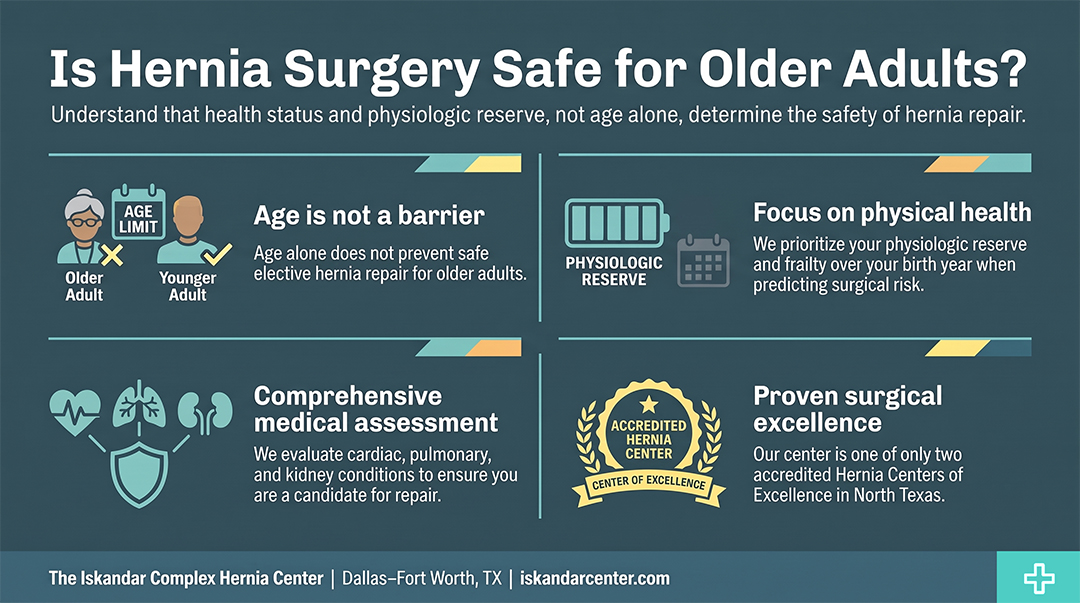
Elective hernia repair is performed safely in older adults, and age alone is not a contraindication. What predicts surgical risk is physiologic reserve, frailty, and specific medical conditions such as cardiac, pulmonary, and kidney disease. Each is assessed before surgery is scheduled. That evaluation, rather than a birth year, determines whether an older patient is a candidate for repair.
The Iskandar Complex Hernia Center is led by Dr. Mazen E. Iskandar, MD, FACS, a board-certified surgeon who has held the Surgeon of Excellence in Hernia Surgery designation since January 2024. The center is one of only two Hernia Centers of Excellence in North Texas, accredited by the Surgical Review Corporation in October 2025.
Is there an age limit for hernia surgery?
There is no fixed upper age limit for hernia repair. As of 2026, repairs are performed in patients in their eighties and nineties. What governs the decision instead is whether the hernia is symptomatic and whether the patient has the physiologic reserve to tolerate an operation and recover from it. Surgeons assess both. Candidacy is confirmed through that evaluation rather than an age cutoff.
What are the risks of leaving a hernia untreated in an older adult?
An untreated hernia can become incarcerated, meaning trapped and no longer reducible, and can progress to strangulation, in which blood supply to that tissue is cut off and emergency surgery is required. Emergency repair carries higher morbidity and mortality than planned elective repair, and the gap is widest in older patients. Femoral hernias carry a disproportionately high strangulation risk. Symptomatic hernias are generally repaired electively, though hernias causing no symptoms are sometimes monitored.
At The Iskandar Complex Hernia Center, patients with symptomatic hernias are evaluated so the decision can be made deliberately rather than in an emergency department. Dr. Iskandar’s practice is limited to complex hernia repair, which allows evaluation to focus on the timing and technique a specific hernia calls for.
What health conditions are assessed when deciding whether an older patient can have hernia surgery?
Preoperative assessment in an older patient covers cardiac function, pulmonary function and chronic lung disease, diabetes and glycemic control, kidney and liver function, nutritional status, cognitive status, mobility and functional independence, and current medications including blood thinners. The purpose is twofold. It establishes whether the patient can tolerate anesthesia and the recovery period, and it identifies conditions that can be improved before surgery.
How is an older patient evaluated before hernia surgery is scheduled?
Evaluation follows a set sequence: consultation and medical history, physical examination, cross-sectional imaging when the hernia is large or complex, structured screening for frailty and functional status, medical clearance and treatment of any conditions found, then scheduling. That step is not a practice-specific addition. As of 2026, the American College of Surgeons geriatric surgery standards define preoperative screening for frailty, nutrition, cognition, and mobility as a recognized standard for older elective surgical patients.
Dr. Iskandar evaluates each patient personally rather than delegating the workup, and his consultations are structured around listening before recommending. Patients who arrive expecting to be told they are too old for surgery instead get a full account of what was assessed and why.
Experience renowned expertise and unparalleled compassion from the leader in hernia repair.
Is anesthesia safe for an elderly patient having hernia surgery?
Anesthesia is administered safely to older adults undergoing hernia repair, with the anesthetic plan matched to the patient’s cardiac, pulmonary, and cognitive status. That plan is selected during the preoperative assessment, and considerations specific to older patients, including postoperative confusion and the return of baseline thinking and memory, are factored into the selection. An anesthesiology assessment is part of the workup.
Does recovery take longer after hernia surgery at an older age?
Recovery of baseline strength and independence often takes longer in older patients. Surgical planning accounts for that. Discharge planning, home support, and early mobility are arranged before surgery, and the measure that matters is the return to independent function rather than the wound healing timeline.
The Iskandar Complex Hernia Center is a solo practice, and Dr. Iskandar follows his own patients through recovery. The surgeon who assessed a patient’s reserve before surgery is the same one reviewing his progress afterward.
Is a robotic-assisted or minimally invasive approach safer for an older patient?
Minimally invasive and robotic-assisted repairs use smaller incisions and less abdominal wall disruption than open repair, which is relevant for patients with limited physiologic reserve. They are not universally applicable. Large or complex defects, including those requiring component separation or abdominal wall reconstruction, are repaired open. Technique is selected from the hernia’s characteristics and the patient’s condition rather than applied as a default.
The Iskandar Center performs robotic-assisted, laparoscopic, and open repairs, including abdominal wall reconstruction and non-mesh options such as the Shouldice repair. Dr. Iskandar’s exclusive focus on complex hernia surgery means the approach is chosen for the hernia rather than limited to a single technique.
Can a patient who was told they are too high-risk for hernia surgery still be a candidate?
Being declined for hernia repair is not always a permanent determination. Some limiting factors are modifiable, including nutritional status, obesity, glycemic control, smoking, deconditioning, and medication management, and can be addressed over a period of weeks to months. Other declines reflect the technical demands of the repair relative to a given practice’s focus rather than the patient’s fitness for surgery. Specialist re-evaluation is how the two are distinguished.
Dr. Iskandar, a Surgeon of Excellence in Hernia Surgery, limits his practice to complex hernia repair, and patients are frequently referred to The Iskandar Complex Hernia Center after being told elsewhere that nothing further can be done. For particularly large hernias, he uses botulinum toxin preparation before repair to relax the abdominal wall muscles.
What should a family member ask at a consultation about an older parent’s hernia surgery?
Six questions cover the candidacy decision: what is being assessed to determine whether the patient can tolerate surgery; whether the hernia is symptomatic enough to warrant repair now; what would happen if repair were delayed; which of the patient’s conditions could be improved before surgery; what recovery of independence is expected to look like; and what symptoms would signal an emergency. Each is answerable at a first consultation.
Consultations at The Iskandar Complex Hernia Center in Waxahachie are structured to answer exactly these questions, and family members are welcome in the room. Dr. Iskandar sees patients from across Dallas–Fort Worth, and his approach is to listen before recommending anything.
Key Takeaways: Hernia Surgery in Older Adults
- Age alone is not a contraindication to elective hernia repair; surgical risk in older adults reflects physiologic reserve, frailty, and specific medical conditions.
- No fixed upper age limit applies to hernia repair; the decision turns on whether the hernia is symptomatic and whether the patient can tolerate surgery.
- Emergency repair after a hernia becomes incarcerated or strangulated carries higher morbidity and mortality than planned elective repair, particularly in older patients.
- Structured preoperative screening for frailty, nutrition, cognition, and mobility is a recognized standard in the evaluation of older elective surgical patients.
- Being declined for surgery is not always permanent; nutritional status, glycemic control, smoking, and deconditioning can often be improved before re-evaluation.
If you are weighing hernia surgery for an older parent, a consultation at The Iskandar Complex Hernia Center in Dallas–Fort Worth is an evaluation of candidacy, not a commitment to an operation. Schedule a consultation.
source https://iskandarcenter.com/hernia-surgery/is-hernia-surgery-safe-for-elderly-patients/

No comments:
Post a Comment