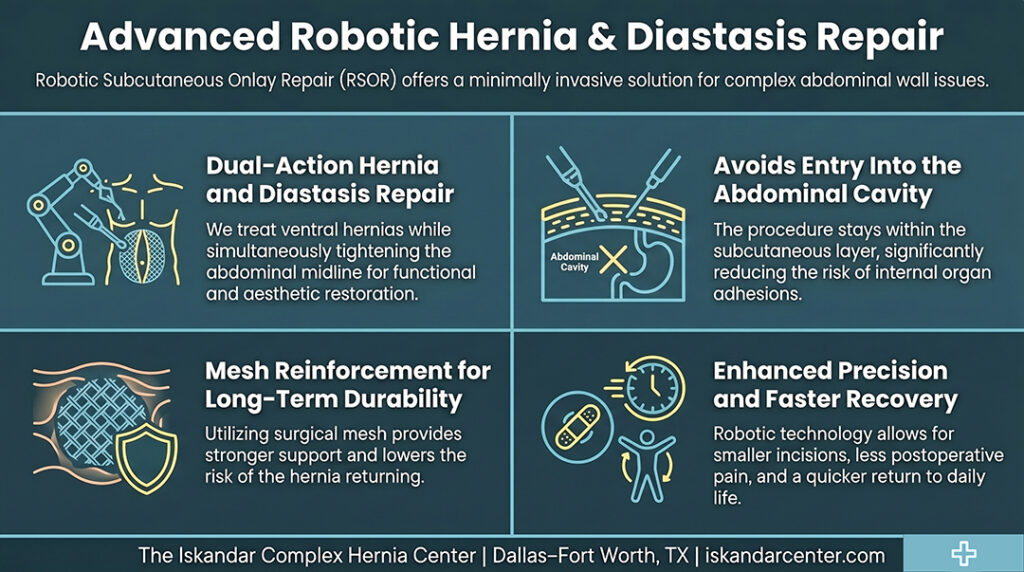
Robotic Subcutaneous Onlay Repair is an advanced minimally invasive procedure used to treat ventral, incisional, and umbilical hernia defects of the abdominal wall that are associated with diastasis recti. This technique utilizes robotics and endoscopy to access the subcutaneous tissue layer beneath the skin and above the muscle, allowing the surgeon to repair the hernia without entering the abdominal cavity. By avoiding deeper planes of the abdomen, this approach reduces certain risks while still reinforcing the abdominal wall with surgical mesh for long-term durability. Surgery in this space also allows for complete plication or tightening of the diastasis similar to what is done in an abdominoplasty or “tummy tuck”. However, no excess skin is removed.
This methodology is gaining attention in the United States as technology continues to evolve and surgeons seek techniques that balance effectiveness, safety, and recovery for the patient.
Technique Overview and Surgical Methodology
During a robotic subcutaneous onlay repair, small incisions in the lower abdomen are made in the skin to allow insertion of robotic instruments. Through careful dissection, a working space is created within the subcutaneous tissue above the fascia of the abdominal wall. This space allows the surgeon to visualize the hernia defect using endoscopy while maintaining precise control through robotics.
Once the hernia sac is reduced, the defect in the muscle is typically closed using surgical suture. Diastasis recti is also addressed to restore proper midline tension and support by plicating or tightening the rectus abdominis muscle along the entire abdomen.
After closure, a surgical mesh is placed over the repaired defect in an onlay position, reinforcing the tissue and distributing tension across the abdominal wall. The mesh is secured using a combination of fixation techniques, which may include additional suture placement depending on the surgeon’s preference and the specific anatomy of the patient.
Anatomical terms of location are critical in this approach, as the procedure takes place entirely within the subcutaneous plane, avoiding entry into deeper layers such as the peritoneal cavity. This distinction separates it from techniques like laparoscopy-based intraperitoneal repairs.
Mesh vs. No Mesh in Robotic Subcutaneous Onlay Repair
In most adult ventral, incisional, and umbilical hernia repairs, surgical mesh lowers the risk of recurrence compared to closing the defect with surgical suture alone. While direct research comparing robotic mesh repair to robotic no-mesh repair is limited, broader hernia research consistently shows that suture-only repair has a higher chance of failure, especially when the hernia defect is 2 cm or larger. Robotics can improve precision, visualization, and suturing, but it does not change the basic principle that fascia repaired under tension is more likely to reopen over time. A mesh-reinforced repair helps distribute tension across the abdominal wall and provides stronger long-term support. No-mesh repair may be considered only in select cases, such as very small primary umbilical hernias in low-risk patients, but the tradeoff is usually a higher recurrence risk.
Indications and Patient Selection
Robotic subcutaneous onlay repair is most commonly indicated for small to moderate ventral hernia defects, including umbilical hernia and select incisional hernia cases. It may also be considered in patients with diastasis recti, where reinforcement of the abdominal wall provides both functional and aesthetic benefits.
This minimally invasive procedure is often appropriate for patients who may benefit from avoiding intraperitoneal surgery, such as those with prior abdominal operations or increased risk of adhesions. Careful evaluation, including imaging and physical examination, helps determine whether this approach is the best option.
Outcomes and Clinical Results
Early research and clinical experience suggest favorable outcomes with robotic subcutaneous onlay repair. Patients often experience reduced postoperative pain, shorter recovery times, and improved cosmetic results due to smaller incisions and minimal disruption of deeper tissue layers.
The use of robotics enhances precision during dissection and suturing, which may improve the overall result and consistency of the repair. While long-term data is still developing, short- to mid-term findings indicate low recurrence rates when surgical mesh is used appropriately.
As with any evolving surgical technique, ongoing research is essential to better understand long-term durability, complication rates, and patient satisfaction compared to other established approaches.
Risks and Potential Complications
Although this technique avoids entering the abdominal cavity, it is not without risk. The most common complication associated with subcutaneous approaches is seroma formation, where fluid collects in the space created during dissection. The risk of seroma formation is lowered by using a drain that is typically removed on the first post-operative visit.
Other potential risks include infection, wound healing issues involving the skin, and discomfort related to mesh placement. In rare cases, patients may experience chronic pain or issues related to the surgical mesh or fixation methods.
Because the repair is performed within the subcutaneous tissue, careful technique is required to minimize damage to surrounding structures and ensure proper healing of the abdominal wall.
Comparison to Other Hernia Repair Techniques
Compared to traditional open onlay repair, the robotic approach reduces trauma to the patient and improves visualization during surgery. Unlike laparoscopy or intraperitoneal techniques, robotic subcutaneous onlay repair avoids placing mesh inside the abdomen, which reduces the risk of adhesion to internal organs.
However, other approaches such as retromuscular or preperitoneal repairs may offer advantages in certain cases, particularly for larger or more complex hernia defects. These techniques position the mesh deeper within the abdominal wall, which may reduce some types of complication.
The choice of technique ultimately depends on the size and location of the hernia, the patient’s anatomy, and the surgeon’s expertise.
Special Considerations
Understanding the anatomy of the abdominal wall, including the relationship between muscle layers, fascia, and subcutaneous tissue, is essential for successful outcomes. Conditions such as prior surgery, altered anatomy, or birth defect-related changes may influence the surgical plan.
In addition, patient-specific factors such as overall health, activity level, and risk factors for recurrence must be considered when selecting the appropriate repair technique.
Evidence and Ongoing Research
Current research on robotic subcutaneous onlay repair is still emerging, with most available data derived from smaller series and early clinical studies. These studies suggest that the technique is safe and effective for appropriately selected patients, particularly those with smaller midline defects.
As more surgeons adopt robotics and refine their methodology, larger studies and comparative trials are expected to provide deeper insight into outcomes, complication rates, and long-term durability.
Dr. Iskandar’s Thoughts on the Technique
Robotic subcutaneous onlay repair is a great option to address small hernias that are associated with diastasis recti. he incisions are typically hidden in the waist line. The ideal candidate for this operation would be someone who is not overweight and without excess skin. If excess skin is present, an abdominoplasty performed by a plastic surgeon would be a better option.
Conclusion
Robotic Subcutaneous Onlay Repair is an innovative minimally invasive procedure that expands the options available for hernia treatment. By combining robotics, endoscopy, and careful anatomical planning, this technique allows surgeons to repair hernia defects while minimizing disruption to the abdomen.
Although further research is needed to fully define its long-term role, early results are promising. For the right patient, this approach can provide an effective balance of safety, recovery, and durable repair of the abdominal wall.
Medically Reviewed By:
Mazen Iskandar, MD, FACS
Board-Certified General Surgeon
Fellowship-Trained Minimally Invasive & Bariatric Surgeon
SRC-Accredited Surgeon of Excellence in Hernia Surgery
Last reviewed June 26, 2026
source https://iskandarcenter.com/hernia-surgery/robotic-subcutaneous-onlay-repair/

No comments:
Post a Comment